Our financial system is crumbling this week.
-
cpebbles

- Perennial All-Star
- Posts: 8829
- Joined: August 30 07, 12:28 pm
Re: Our financial system is crumbling this week.
It's cool, the GOP is going to sponsor another bill that allows him to pay more taxes if he wants.
-
longhornbaseball

- Perennial All-Star
- Posts: 5527
- Joined: April 18 06, 10:37 pm
Re: Our financial system is crumbling this week.
Households don't borrow from foreigners in order to consume foreign products. The build up in household debt was due primarily to deregulation of the financial sector that allowed people who shouldn't have to borrow money. I think the government budget surpluses of the late 90's were at least a contributing (if not major) factor that started the run up in private debt.Hungary Jack wrote:How does one explain massive consumer debt and public debt (at all levels) through sector balances? The obvious answer is burrowing from abroad. Those debts have to be repaid, which means less money for domestic consumption or investment.
I'll use China as an example on foreign borrowing. When we trade with China, they send us goods and we send them dollars. They can't "lend" to us until we send them dollars. With the dollars they accumulate, there are four things they can do (I may be missing something but I think this covers all of their options):
1. Simply hold on to their dollars at the Federal Reserve and earn no interest.
2. Exchange them in the forex markets for yen, euros, etc...
3. Buy risky dollar denominated assets such as stocks, corporate bonds, and real estate (they've done some of this).
4. Buy treasury securities and earn risk free returns.
For option 1, they earn no return on their money, so they obviously won't do that. Option 2 will cause the dollar to depreciate relative to foreign currencies (including renminbi). This will increase the price of imports relative to exports in the US, which will reverse the trade gap and effectively end the Chinese mercantilist growth strategy. They are still dependent on exports to the US for growth, so they won't do that. Also, they would have to invest their newly acquired foreign currencies in foreign assets. Do you think they feel good about their European debt investments? Option 3 can get politically sticky when they try to make major investments in private US companies (like when CNOOC tried to buy Unocal). That leaves option 4. As long as they continue to export heavily to the US, they will continue to buy treasury securities. But once again, we don't need them to buy those securities so we can finance our spending on their goods and services. It's not a chicken or egg argument. We clearly send them dollars before they lend us dollars.
HJ, solvency is NEVER an issue. The only possible adverse effect from continuously high levels of government spending is inflation. We need to be worried about this when employment is no longer an issue, and there is too much aggregate demand in the economy. We are years away from that. Reducing the deficit (or even worse, balancing the budget) will cause our bad situation to get a whole lot worse.Hungary Jack wrote:I agree that solvency is a false issue right now. Liquidity is plentiful. But continued borrowing at high levels almost guarantee future tax increases, taking money out of consumer pockets.
Employment in the manufacturing sector has been declining, but output is actually growing (though it took a hit with the recession). The red line is employment and the blue line is output. The reason we import so much from China is because they keep their currency devalued relative to the dollar, which keeps unit labor costs down, and allows us to buy their goods at a lower price. This is a good thing for US consumers, because it lowers the cost of our consumption in real terms. This is a bad thing for manufacturing employees, because they are replaced by cheaper Chinese workers. The real issue we face is labor mobility. It is easy for highly skilled workers to move to lower skilled jobs, but it is not as easy for lower skilled workers to become skilled. Tariffs aren't the answer. What we need is better education and vocational training.cards2468 wrote:Bingo. You can cut spending all you want, you can increase taxes all you want, but if we can't fix the trade defecit, we're going no where. This is why we need to seriously look at cutting corporate taxes (replace it with income tax or something of that variety) and raise tariffs. It's not about nationalism, but rather ending the trend of our nation moving towards being a service economy when we have great abilities to produce products.

-
vinsanity

- Chili dog truther
- Posts: 8836
- Joined: July 3 06, 2:19 pm
- Location: Indianapolis
Re: Our financial system is crumbling this week.
I don't think the issue is as much with higher skilled workers moving to lower skilled jobs, unless you're referring to strictly a 'blue-collar' type. i.e. a skilled cabinet maker could work in home construction, but a guy swinging a hammer building a house isn't likely able to make fine cabinets. Most middle-management/IT/Sales types aren't likely to move down to swinging a hammer for an income.longhornbaseball wrote:This is a good thing for US consumers, because it lowers the cost of our consumption in real terms. This is a bad thing for manufacturing employees, because they are replaced by cheaper Chinese workers. The real issue we face is labor mobility. It is easy for highly skilled workers to move to lower skilled jobs, but it is not as easy for lower skilled workers to become skilled. Tariffs aren't the answer. What we need is better education and vocational training.
Ali Velshi was on TDS last night and mentioned that employment is the biggest problem, but moreso because less skilled workers are having trouble finding jobs that we 'need' right now. His proposal was having the government 'guarantee' loans for those unemployed, less skilled workers to learn how to be nurses, computer techs, mechanics, plumbers etc so we have more skilled workers in the work force who will earn and earn more paying income taxes on those wages and end up being a net gain for the government.
I'm not sure if that means paying for the educational programs or offering extremely cheap loans similar to student loans to help it happen.
-
Hungary Jack

- Mother Earth
- Posts: 19536
- Joined: July 24 06, 6:03 am
- Location: In Cognito
Re: Our financial system is crumbling this week.
Right. Our government spends more than it takes in. These dollars go into the domestic economy. We import consumer goods, and the dollars earned by our trading partners finance the government spending through Treasury purchases.longhornbaseball wrote:Households don't borrow from foreigners in order to consume foreign products. The build up in household debt was due primarily to deregulation of the financial sector that allowed people who shouldn't have to borrow money. I think the government budget surpluses of the late 90's were at least a contributing (if not major) factor that started the run up in private debt.Hungary Jack wrote:How does one explain massive consumer debt and public debt (at all levels) through sector balances? The obvious answer is burrowing from abroad. Those debts have to be repaid, which means less money for domestic consumption or investment.
I'll use China as an example on foreign borrowing. When we trade with China, they send us goods and we send them dollars. They can't "lend" to us until we send them dollars. With the dollars they accumulate, there are four things they can do (I may be missing something but I think this covers all of their options):
1. Simply hold on to their dollars at the Federal Reserve and earn no interest.
2. Exchange them in the forex markets for yen, euros, etc...
3. Buy risky dollar denominated assets such as stocks, corporate bonds, and real estate (they've done some of this).
4. Buy treasury securities and earn risk free returns.
For option 1, they earn no return on their money, so they obviously won't do that. Option 2 will cause the dollar to depreciate relative to foreign currencies (including renminbi). This will increase the price of imports relative to exports in the US, which will reverse the trade gap and effectively end the Chinese mercantilist growth strategy. They are still dependent on exports to the US for growth, so they won't do that. Also, they would have to invest their newly acquired foreign currencies in foreign assets. Do you think they feel good about their European debt investments? Option 3 can get politically sticky when they try to make major investments in private US companies (like when CNOOC tried to buy Unocal). That leaves option 4. As long as they continue to export heavily to the US, they will continue to buy treasury securities. But once again, we don't need them to buy those securities so we can finance our spending on their goods and services. It's not a chicken or egg argument. We clearly send them dollars before they lend us dollars.
My point is that if our domestic private and public sectors are running deficits, where is the credit coming from? And more importantly, how sustainable is it? It's a recipe for debasing your currency and high inflation in the long run. And high inflation obviously favors debtors, so maybe we'll just inflate our debts away.
But I agree completely that inflation is in check despite the inflationary fiscal and monetary policies in practice, and employment is THE issue right now.
-
longhornbaseball
- Perennial All-Star
- Posts: 5527
- Joined: April 18 06, 10:37 pm
Re: Our financial system is crumbling this week.
Again, I feel compelled to say their Treasury purchases aren't really financing government spending. If the money had been spent on domestic goods, it likely would have still ended up in Treasury securities.Hungary Jack wrote:Right. Our government spends more than it takes in. These dollars go into the domestic economy. We import consumer goods, and the dollars earned by our trading partners finance the government spending through Treasury purchases.
Not sustainable!!! Exactly! The build up in consumer debt inflated the housing bubble that eventually burst and led to the financial crisis. The private credit came from banks.Hungary Jack wrote:My point is that if our domestic private and public sectors are running deficits, where is the credit coming from? And more importantly, how sustainable is it?
It's a recipe for a Minskyan financial crisis, which is what we got. But we didn't get it because the government ran deficits. We got it because the private sector was addicted to debt.Hungary Jack wrote:It's a recipe for debasing your currency and high inflation in the long run. And high inflation obviously favors debtors, so maybe we'll just inflate our debts away.
My whole point is that current fiscal and monetary policies are not inflationary given the current environment. If we still have ~10% budget deficits and zero interest rates when employment is back to normal levels, inflation will be a serious threat.Hungary Jack wrote:But I agree completely that inflation is in check despite the inflationary fiscal and monetary policies in practice, and employment is THE issue right now.
-
Hungary Jack
- Mother Earth
- Posts: 19536
- Joined: July 24 06, 6:03 am
- Location: In Cognito
Re: Our financial system is crumbling this week.
OK. I am starting to follow this more clearly. Thanks for explaining it.
You are saying that the financial crisis is largely about bad consumer credit from the financial sector. Totally agree, though I think the GSE's had a pretty pivotal role in the mortgage mess as an enabler. Most figures I have seen claim that the GSE's hold roughly half of the mortgages in the US, and perhaps a larger share of the bad ones.
And it is the federal government using taxpayer funds that largely bailed out the private finance sector. In effect, the private debts have been assumed by the public sector (though thankfully TARP has largely been repaid).
If you enact a strict regulatory regime to restrict private credit, you likely increase the role of the public sector in extending credit to the lower part of the spectrum that might benefit most from it. Many here believe, with good reason, that the government has been co-opted by corporate interests, and thus a government program to extend credit to poor risks will largely benefit private corporations while the government bears the risk. We are back to where we started.
But I don't think we'll solve these policy issues here. My main point is that the line between public and private finance has become quite blurry with our federal government becoming the lender of last resort.
You are saying that the financial crisis is largely about bad consumer credit from the financial sector. Totally agree, though I think the GSE's had a pretty pivotal role in the mortgage mess as an enabler. Most figures I have seen claim that the GSE's hold roughly half of the mortgages in the US, and perhaps a larger share of the bad ones.
And it is the federal government using taxpayer funds that largely bailed out the private finance sector. In effect, the private debts have been assumed by the public sector (though thankfully TARP has largely been repaid).
If you enact a strict regulatory regime to restrict private credit, you likely increase the role of the public sector in extending credit to the lower part of the spectrum that might benefit most from it. Many here believe, with good reason, that the government has been co-opted by corporate interests, and thus a government program to extend credit to poor risks will largely benefit private corporations while the government bears the risk. We are back to where we started.
But I don't think we'll solve these policy issues here. My main point is that the line between public and private finance has become quite blurry with our federal government becoming the lender of last resort.
-
cpebbles
- Perennial All-Star
- Posts: 8829
- Joined: August 30 07, 12:28 pm
Re: Our financial system is crumbling this week.
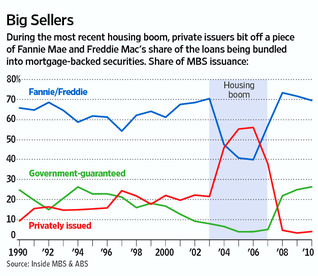
Everything I read when the bubble burst indicated that, counter to the Fannie/Freddie scapegoating, the private sector had jumped into the subprime market headfirst and held the risky mortgages that even the GSEs wouldn't touch.
-
cards2468

- Hall Of Famer
- Posts: 14745
- Joined: October 28 06, 11:10 pm
- Location: LOVE IT OR LEAVE IT
Re: Our financial system is crumbling this week.
Excellent discussion. At this point I don't think I can contribute much, but I'm enjoying reading it at least.
How is manufacturing output measured? A decent portion of work is subcontracted out overseas with final assembly occuring in the US, so I'm curious if that's where the employment isn't matching the output.
How is manufacturing output measured? A decent portion of work is subcontracted out overseas with final assembly occuring in the US, so I'm curious if that's where the employment isn't matching the output.
-
Hungary Jack
- Mother Earth
- Posts: 19536
- Joined: July 24 06, 6:03 am
- Location: In Cognito
Re: Our financial system is crumbling this week.
So the GSEs hold only the good mortgages? I don't think so. There was a lot of crap foisted upon private investors through CDOs, but many of the bad mortgages were guaranteed by the GSEs.cpebbles wrote:Everything I read when the bubble burst indicated that, counter to the Fannie/Freddie scapegoating, the private sector had jumped into the subprime market headfirst and held the risky mortgages that even the GSEs wouldn't touch.
-
Arthur Dent
- Hall Of Famer
- Posts: 12536
- Joined: April 25 06, 6:43 pm
- Location: Austin
Re: Our financial system is crumbling this week.
We've had this discussion how many times before? You seem rather immune to evidence. Once again:Hungary Jack wrote:I think the GSE's had a pretty pivotal role in the mortgage mess as an enabler. Most figures I have seen claim that the GSE's hold roughly half of the mortgages in the US, and perhaps a larger share of the bad ones.