Some of the lack of need for new employees has been caused by companies pushing their current workforce to work more hours more efficiently.
Some of that could be pulled back a bit by modifying labor and healthcare laws. Right now it's financially better to work three people 150 hours instead of four 160 hours. You pay less in health care costs, have more flexibility to decrease hours without losing staff, lose less man-hours to vacation/sickness, pay less in training, have less overhead in middle management (less employees = less managers), etc.
So what incentive does a company have to hire additional staff when they can squeeze extra work out of their current workforce? The low hiring rate means employees are less likely to leave than ever before and the lack of jobs means replacing someone who does with another qualified candidate is very easy.
The only way to get out of that sort of cycle is through unprecidended growth, unionization or legislation.
Our financial system is crumbling this week.
-
TheoSqua

- Next Gen Wart
- Posts: 8949
- Joined: April 22 06, 6:53 pm
- Location: St. Louis
- Contact:
-
IMADreamer

- Has an anecdote about a townie he overheard.
- Posts: 12877
- Joined: December 6 10, 1:09 am
- Location: Illinois
Re: Our financial system is crumbling this week.
I think the only way to get out of this cycle is to have wall street run red with the blood of wall street types. I don't know.
-
robbotis

- Perennial All-Star
- Posts: 4791
- Joined: April 18 06, 7:05 am
- Location: Minneapolis
Re: Our financial system is crumbling this week.
It's true. And the answer to the other 2 questions too.IMADreamer wrote:I think the only way to get out of this cycle is to have wall street run red with the blood of wall street types. I don't know.
Businesses aren't hiring, because they can make their current workers work harder, longer, and cheaper. All while they get fat and happy. And Wall Street loves it. They get even fatter by doing nothing but keeping the system in place. The inequality of wealth is staggering. I'm not going to claim I have the answer, but something needs to change.
A person shouldn't work 40 hours a week (and no, they shouldn't need to work more, it' s all ready more than 99% of the world's workforce) and have their family live in or near poverty.
-
AWvsCBsteeeerike3
- "I could totally eat a pig butt, if smoked correctly!"
- Posts: 27559
- Joined: August 5 08, 11:24 am
- Location: Thinking of the Children
Re: Our financial system is crumbling this week.
Right. This we agree on.robbotis wrote: A person shouldn't work 40 hours a week (and no, they shouldn't need to work more, it' s all ready more than 99% of the world's workforce) and have their family live in or near poverty.
-
AWvsCBsteeeerike3
- "I could totally eat a pig butt, if smoked correctly!"
- Posts: 27559
- Joined: August 5 08, 11:24 am
- Location: Thinking of the Children
Re: Our financial system is crumbling this week.
I'm sure workers are being leaned on heavier. I'm sure there's a chart that illustrates this somewhere and companies could hire a couple more workers here and there. But, what has changed? Has legislation changed allowing companies to squeeze more from their workers? Have unions been busted as compared to 10-20 years ago making the work conditions less and less favorable? I don't know the answer to either of those questions, per se, but I'd guess it's more the economy as a whole than any particular change to the governing systems.TheoSqua wrote:Some of the lack of need for new employees has been caused by companies pushing their current workforce to work more hours more efficiently.
Some of that could be pulled back a bit by modifying labor and healthcare laws. Right now it's financially better to work three people 150 hours instead of four 160 hours. You pay less in health care costs, have more flexibility to decrease hours without losing staff, lose less man-hours to vacation/sickness, pay less in training, have less overhead in middle management (less employees = less managers), etc.
So what incentive does a company have to hire additional staff when they can squeeze extra work out of their current workforce? The low hiring rate means employees are less likely to leave than ever before and the lack of jobs means replacing someone who does with another qualified candidate is very easy.
The only way to get out of that sort of cycle is through unprecidended growth, unionization or legislation.
Or to ask the same question another way, if things are the same as 10 years ago, and companies are more profitable now than at that time, why didn't they make the same changes 10 years ago?
-
AWvsCBsteeeerike3
- "I could totally eat a pig butt, if smoked correctly!"
- Posts: 27559
- Joined: August 5 08, 11:24 am
- Location: Thinking of the Children
Re: Our financial system is crumbling this week.
Pretty decent on article on the disparity between the economy and the stock market.
http://www.washingtonpost.com/blogs/won ... -congress/
http://www.washingtonpost.com/blogs/won ... -congress/
Huzzah! Hang the celebratory banners! Unleash the confetti! Happy days are here again. The Dow Jones industrial average closed yesterday at 14,253.77!
...
But the biggest reason to discount the importance of the stock market reaching a new high is this: It hasn’t been matched by a similar increase in the incomes and job prospects of Americans. The Dow may be back to its old highs, but it sure doesn’t feel like it. There is nearly a $1 trillion gap between what the U.S. economy is capable of producing and what it’s actually producing, the unemployment rate is hovering around 8 percent, and the average earnings in the private sector, adjusted for inflation, have barely budged for five years.
....
So right now, the Fed’s quantitative easing policies are now pushing an extra $85 billion per month into the financial system, on top of about $2 trillion from its previous efforts. It is buying a mix of Treasury bonds (which help lower U.S. government borrowing costs) and mortgage backed securities (which help lower mortgage rates). A key operating theory at the Fed of how these help growth is known as the “portfolio balance channel.” The Fed buys securities. The investors who otherwise would have bought those bonds have to invest in something else. Maybe it’s corporate debt, maybe it’s the stock market, but either way it props up private asset prices and makes it cheaper and more desirable for companies to invest. Higher prices for stocks and other assets also has “wealth effects,” making the people who own those securities feel richer and therefore more willing to spend. It is no coincidence that the rally in the stock market over the last few days has come about following speeches by the No. 1 and No. 2 Fed officials that suggested that QE policies aren’t going away anytime soon.
But the problem is those effects largely benefit the wealthy, at least through their direct effects.
-
pioneer98

- Hall Of Famer
- Posts: 22007
- Joined: July 15 08, 8:24 pm
- Location: High A Minors
Re: Our financial system is crumbling this week.
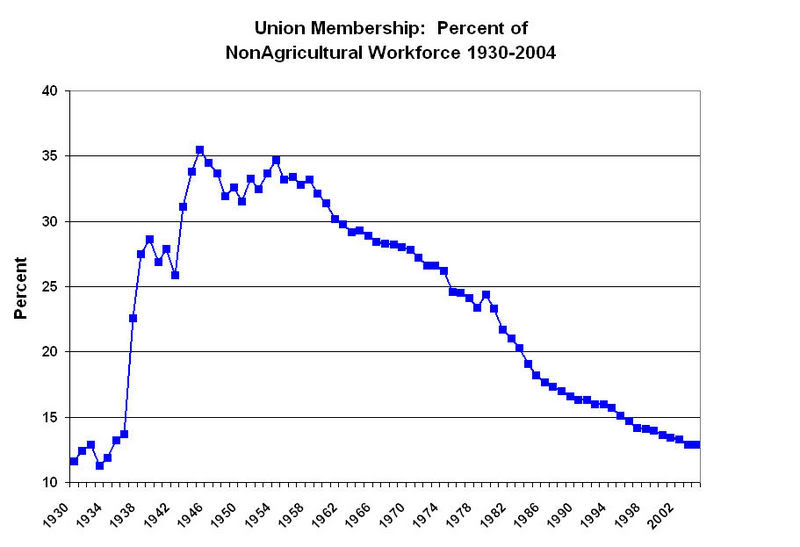
There has been a huge shift away from unions. They have been attacked directly - like changing "right to work" laws (the crap in Wisconsin, Michigan, etc). Unions have also been attacked indirectly. We allow the uninhibited expansion of non-union companies like Wal-Mart and many others....and heck, we even give them tax incentives to expand! The unions that are left are not strong ones. For all the talk of unions being a powerful "special interest" group, their interests aren't being treated too special lately. But even all this seems more like a symptom of the problem and not the root cause. It seems more like a cultural shift has taken place and anti-unionism is just one symptom, along with deregulation, and many other trends.
Just another example of a symptom: I read an article the other day about the budget debate in Iowa. The Republican governor thinks we need to give more tax breaks to big corporations. The Democrats in charge of the Senate made a bold counter: they think instead we should give tax breaks to smaller businesses. I think they are both wrong. How about we keep taxes where they are, and we use that money to keep teachers and state troopers employed?
Just another example of a symptom: I read an article the other day about the budget debate in Iowa. The Republican governor thinks we need to give more tax breaks to big corporations. The Democrats in charge of the Senate made a bold counter: they think instead we should give tax breaks to smaller businesses. I think they are both wrong. How about we keep taxes where they are, and we use that money to keep teachers and state troopers employed?
-
pioneer98
- Hall Of Famer
- Posts: 22007
- Joined: July 15 08, 8:24 pm
- Location: High A Minors
Re: Our financial system is crumbling this week.
The bailout might have been the ultimate "trickle down" stimulus. We don't know what happened behind closed doors, and we don't know all the terms of the bailout (I don't believe the terms are public knowledge). What if the Fed basically said, yes, we'll cover your losses 100 cents on the dollar, but as soon as you are able, you have to spend some of this money to stimulate the economy. Not that it worked or anything, but maybe the Fed tried some kind of gambit like that there.AWvsCBsteeeerike3 wrote:Pretty decent on article on the disparity between the economy and the stock market.
http://www.washingtonpost.com/blogs/won ... -congress/
Huzzah! Hang the celebratory banners! Unleash the confetti! Happy days are here again. The Dow Jones industrial average closed yesterday at 14,253.77!
...
But the biggest reason to discount the importance of the stock market reaching a new high is this: It hasn’t been matched by a similar increase in the incomes and job prospects of Americans. The Dow may be back to its old highs, but it sure doesn’t feel like it. There is nearly a $1 trillion gap between what the U.S. economy is capable of producing and what it’s actually producing, the unemployment rate is hovering around 8 percent, and the average earnings in the private sector, adjusted for inflation, have barely budged for five years.
....
So right now, the Fed’s quantitative easing policies are now pushing an extra $85 billion per month into the financial system, on top of about $2 trillion from its previous efforts. It is buying a mix of Treasury bonds (which help lower U.S. government borrowing costs) and mortgage backed securities (which help lower mortgage rates). A key operating theory at the Fed of how these help growth is known as the “portfolio balance channel.” The Fed buys securities. The investors who otherwise would have bought those bonds have to invest in something else. Maybe it’s corporate debt, maybe it’s the stock market, but either way it props up private asset prices and makes it cheaper and more desirable for companies to invest. Higher prices for stocks and other assets also has “wealth effects,” making the people who own those securities feel richer and therefore more willing to spend. It is no coincidence that the rally in the stock market over the last few days has come about following speeches by the No. 1 and No. 2 Fed officials that suggested that QE policies aren’t going away anytime soon.
But the problem is those effects largely benefit the wealthy, at least through their direct effects.
-
pioneer98
- Hall Of Famer
- Posts: 22007
- Joined: July 15 08, 8:24 pm
- Location: High A Minors
Re: Our financial system is crumbling this week.
It's more like this: stockholders and investors simply demand a higher return on investment than they used to. They aren’t content with 8% or 10% per year any more. They want 15%, and they want it by next quarter.AWvsCBsteeeerike3 wrote:Not to pick on you, but I see this all the time. Is the problem that businesses aren't hiring workers or is it that businesses don't need workers? It is weird to say: Businesses rolling in the dough (implying they are doing great), still aren't hiring workers (implying they are doing something wrong).robbotis wrote: These businesses rolling in the dough, still aren't hiring workers.
Demand/consumers push a business to hire more employees, not profits. Unless the argument is that a business ought to just hire people to do nothing because they can, then I don't get the argument.
Rather it seems the system, overall, has changed and businesses don't need as many workers. How do you bring those jobs back? I don't know.
But, it's tough to blame businesses in general for not hiring people they don't need.
Example: the City of Davenport bought and refurbished a neat old building that had been neglected and languishing in a prime location downtown a few years ago. I believe they still own it, or if not, some realtor bought it off them for cheap. Whatever the case, they initially rented out the ground floor to an upscale corporate chain restaurant. It was very popular, and had very long waits on weekends. After about a year, the corporation closed the restaurant. Oh, the restaurant was making a profit. That was not the issue. The problem was that the profit was not quite as high as they would have liked, even with the subsidized rent. So they shut it down. Since then, a more local chain went in there with an extremely similar concept, and has been there for 3+ years now. The profit levels are just fine for them, for now (unless/until they decide to get greedy).
Didn't the same thing happen with Wonder Bread? Didn't it still had a profitable business, but it was just not quite profitable enough any more for the people in charge?
-
AWvsCBsteeeerike3
- "I could totally eat a pig butt, if smoked correctly!"
- Posts: 27559
- Joined: August 5 08, 11:24 am
- Location: Thinking of the Children
Re: Our financial system is crumbling this week.
Maybe I'm just naive, but where are you getting that investors demand a higher return? Obviously higher returns make a company look better on paper, but if that was the case, a simple search could be done on which companies have the highest roe and profit margins and buy only those stocks.
But, that's not what is happening. This seems to be more the case of a rising tide floating all ships. And, that rising tide is more likely the effects of the feds quantitative easing than investors finally seeing businesses' profit margins or ROE numbers lucrative enough to get them back in the market, imho. If the later was the case, investors would have no reason to hedge their bets by shorting the markets (which they're doing). Gold got too expensive, the feds started dumping money into the markets, so they realized 'don't fight the fed' is a pretty good statement....again, imho.
The the QE ended tomorrow, the markets would plummet and would stay down. If a company has a bad/good quarter, the stocks bounce but rebound in a day or so.
But, that's not what is happening. This seems to be more the case of a rising tide floating all ships. And, that rising tide is more likely the effects of the feds quantitative easing than investors finally seeing businesses' profit margins or ROE numbers lucrative enough to get them back in the market, imho. If the later was the case, investors would have no reason to hedge their bets by shorting the markets (which they're doing). Gold got too expensive, the feds started dumping money into the markets, so they realized 'don't fight the fed' is a pretty good statement....again, imho.
The the QE ended tomorrow, the markets would plummet and would stay down. If a company has a bad/good quarter, the stocks bounce but rebound in a day or so.