Guys - cryptocurrencies and that physical gold... can't lose.
*jackofdiamonds was a financial advisor and CFP and in no way, shape, or form does this constitute financial advice.
**HODL
Investing for Retirement
-
JackofDiamonds

- Bringer of Boston Baked Blue Balls
- Posts: 15010
- Joined: April 16 06, 9:15 pm
-
Michael
- GRB Founder
- Posts: 35303
- Joined: December 31 69, 6:00 pm
- Location: Chicago, IL
- Contact:
Re: Investing for Retirement
In this post is going to discuss withdrawal rules and international investing. It's a bit in the weeds, but I have a tldr summary at the end if you understandably don't want to read through this.
If you've been following my posts in this thread you may have noticed I have three main strategies for retirement planning:
1) When possible, prioritize retirement investing in tax deferred accounts like 401ks or IRAs.
2) Implement a 3 fund portfolio. A 3 fund portfolio is an effective, diversified, easy and low cost way to invest. The core three components of a "3 fund portfolio" are US stocks, International stocks and US bonds via low cost index funds.
3) To estimate when I have enough money to retire I'll use the Trinity Study withdrawal rules. The Trinity Study back tests a portfolio (more of this later) to determine if it would fail if you retired with the exact same market conditions past markets. For example, what would happen if you retired a year before the Wall Street crash of 1929, etc? Basically, the study determined if you have a 50/50% stocks to bonds portfolio it would have been safe to withdraw 4% the first year and then adjust for inflation for the next 29 years. That includes retiring a year before the crash of 1929. It's a conservative withdrawal approach that doesn't include things like social security, but in my opinion it's a very good starting point.
However, a criticism of my approach is the Trinity Study (point #3) doesn't include international stocks with their back testing. Their portfolio is all US stocks and US bonds. However, I believe international investing is worthwhile for various reasons I outline here and it's a part of the 3 fund approach I outlined in point #2 above.
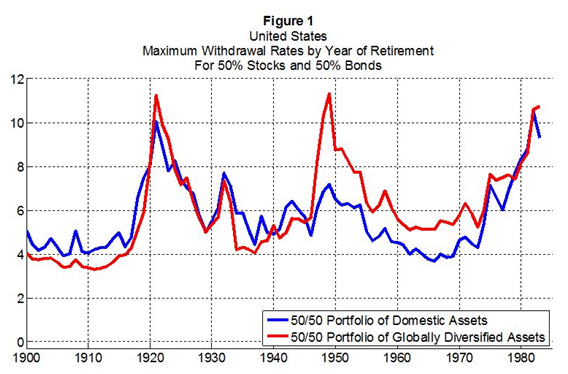
So the question is - how does adding international equities impact back tested 4% withdrawal rule? The answer is not much. However, since the end of WW2 adding international to a portfolio, in most cases, would have decreased the chance of portfolio failure using different withdrawal rates:
ltdr: Adding international equities diversification in most back tested cases doesn't negatively impact the 4% withdrawal rule and in more recent history mostly improves the maximum you can withdraw. I will continue to invest internationally via the 3 fund portfolio and use back tested withdrawal rules as a starting point for retirement decisions.
If you've been following my posts in this thread you may have noticed I have three main strategies for retirement planning:
1) When possible, prioritize retirement investing in tax deferred accounts like 401ks or IRAs.
2) Implement a 3 fund portfolio. A 3 fund portfolio is an effective, diversified, easy and low cost way to invest. The core three components of a "3 fund portfolio" are US stocks, International stocks and US bonds via low cost index funds.
3) To estimate when I have enough money to retire I'll use the Trinity Study withdrawal rules. The Trinity Study back tests a portfolio (more of this later) to determine if it would fail if you retired with the exact same market conditions past markets. For example, what would happen if you retired a year before the Wall Street crash of 1929, etc? Basically, the study determined if you have a 50/50% stocks to bonds portfolio it would have been safe to withdraw 4% the first year and then adjust for inflation for the next 29 years. That includes retiring a year before the crash of 1929. It's a conservative withdrawal approach that doesn't include things like social security, but in my opinion it's a very good starting point.
However, a criticism of my approach is the Trinity Study (point #3) doesn't include international stocks with their back testing. Their portfolio is all US stocks and US bonds. However, I believe international investing is worthwhile for various reasons I outline here and it's a part of the 3 fund approach I outlined in point #2 above.
So the question is - how does adding international equities impact back tested 4% withdrawal rule? The answer is not much. However, since the end of WW2 adding international to a portfolio, in most cases, would have decreased the chance of portfolio failure using different withdrawal rates:
Of the 20 countries, only in Denmark, Germany, and Japan did globally diversified portfolio improve results less than half the time. For the U.S., the results were evenly split, though most countries had better overall results with the globally diversified portfolio.
Figure 1 illustrates the historical results for the U.S. We know from the previous table that the red line (globally diversified) is above the blue line (domestic assets) in half of the cases. This figure illustrates the historical trend of that division more clearly. Retirees in the early 1900s were better off with domestic portfolios. But from the end of World War II until about 1980, globally diversified portfolios provided significantly better results than domestic-only portfolios.
ltdr: Adding international equities diversification in most back tested cases doesn't negatively impact the 4% withdrawal rule and in more recent history mostly improves the maximum you can withdraw. I will continue to invest internationally via the 3 fund portfolio and use back tested withdrawal rules as a starting point for retirement decisions.
-
IMADreamer

- Has an anecdote about a townie he overheard.
- Posts: 12890
- Joined: December 6 10, 1:09 am
- Location: Illinois
Re: Investing for Retirement
Not that it's any of my business, but are you guys basically doing index/mutual funds? or your own version of that which is what it looks like Michael is doing? Anyone using real estate or land as a means to the end in this? I sometimes feel spread out. My stocks/bonds are basically auto pilot vangaurd targeted retirement funds. However I have a couple rental properties and then land which I currently use for farming, but someday will be cash rented out. Taxes and all that get pretty complicated especially with income in two states. However I can always hear my Grandfather say "don't put all your eggs in one basket." Which is ironic since his retirement plan was 100% farm land.
I agree that this is my favorite thread on this site, well maybe the 2011 game 6 thread, but definitely this is second. I wish I knew what I know now 20 years ago. Wish I knew you guys then. My family just never did "stocks and bonds" and I missed so many good years just having money sitting.
I agree that this is my favorite thread on this site, well maybe the 2011 game 6 thread, but definitely this is second. I wish I knew what I know now 20 years ago. Wish I knew you guys then. My family just never did "stocks and bonds" and I missed so many good years just having money sitting.
-
greenback44
- Hall Of Famer
- Posts: 11664
- Joined: June 26 06, 8:54 pm
- Location: In a Small Town with Jack and Diane
Re: Investing for Retirement
Yes, because I don't have time for the other stuff. Philosophically, I'm convinced beating index returns isn't that hard, but you actually have to know what's going on in your local real estate market, or about the company you own stock in, or the company you're shorting to zero. As a practical matter there are precious few people who actually do their homework though.IMADreamer wrote:Not that it's any of my business, but are you guys basically doing index/mutual funds? or your own version of that which is what it looks like Michael is doing?
-
G. Keenan

- Sucking on the Rally Nipple
- Posts: 23718
- Joined: April 16 06, 6:03 pm
- Location: Chicago
Re: Investing for Retirement
So what are our thoughts on life insurance? I'm looking for life insurance and thinking something like a 30 year term policy is probably my best bet here at age 36, but should I give a second thought to these whole life or "universal" policies that accrue cash value indexed to an exchange? Those seem like a waste of money to me, but maybe not? Companies that people like?
-
Michael
- GRB Founder
- Posts: 35303
- Joined: December 31 69, 6:00 pm
- Location: Chicago, IL
- Contact:
Re: Investing for Retirement
I looked in to this and I've never seen an insurance program that has an investment angle that's a good deal. In fact, they're typically horrible deals. Here's a boglehead thread on the topic that's worth a read. The message board is full threads with people complaining about them.G. Keenan wrote:So what are our thoughts on life insurance? I'm looking for life insurance and thinking something like a 30 year term policy is probably my best bet here at age 36, but should I give a second thought to these whole life or "universal" policies that accrue cash value indexed to an exchange? Those seem like a waste of money to me, but maybe not? Companies that people like?
This might be a dumb question - if you don't have kids (or maybe an announcement is on the way), why do you need life insurance? Ultimately, I don't have kids and my wife works, so we decided to forego additional life insurance outside of what's automatically provided at work. FWIW, I can understand needing long-term disability insurance (my job provides this).
Edit -
With LT disability you might need to consider the assets you're protecting. Depending on your net worth it might be better to save the money and assume you'll go bankrupt. That way you can be eligible for something like medicaid if a debilitating event occurs. I'm not remotely an expert when it comes to this stuff so YMMV.
-
G. Keenan
- Sucking on the Rally Nipple
- Posts: 23718
- Joined: April 16 06, 6:03 pm
- Location: Chicago
Re: Investing for Retirement
No kids and no plan to ever have kids, but my wife is a first generation college student who had to borrow every penny to go to school. Consequently she now has about $180k in student loan debt, the repayments of which eat up most of her monthly take home pay (good job America). I am the primary breadwinner for the foreseeable future and if I died she would immediately be underwater on our mortgage. I want a life insurance policy that would pay off our mortgage, pay off her student loans, and cover her monthly expenses for a few years. By my estimate a $500k policy would do that pretty comfortably. The fixed monthly premium for that is like $35 - $40, which is not bad.Michael wrote:I looked in to this and I've never seen an insurance program that has an investment angle that's a good deal. In fact, they're typically horrible deals. Here's a boglehead thread on the topic that's worth a read. The message board is full of people complaining about them.G. Keenan wrote:So what are our thoughts on life insurance? I'm looking for life insurance and thinking something like a 30 year term policy is probably my best bet here at age 36, but should I give a second thought to these whole life or "universal" policies that accrue cash value indexed to an exchange? Those seem like a waste of money to me, but maybe not? Companies that people like?
This might be a dumb question - if you don't have kids (or maybe an announcement is on the way), why do you need life insurance? Ultimately, I don't have kids and my wife works, so we decided to forego additional life insurance outside of what's automatically provided at work. FWIW, I can understand needing long-term disability insurance (my job provides this).
Edit -
With LT disability you might need to consider the assets you're protecting. Depending on your net worth it might be better to save the money and assume you'll go bankrupt. That way you can be eligible for something like medicaid if a debilitating event occurs. I'm not remotely an expert when it comes to this stuff so YMMV.
-
Michael
- GRB Founder
- Posts: 35303
- Joined: December 31 69, 6:00 pm
- Location: Chicago, IL
- Contact:
Re: Investing for Retirement
Thanks. My next question - is your life worth more than $500k? In my experience the answer is "no" so I'd order a hit on you if I were the beneficiary. Your wife might feel differently.
I believe student loans can't be erased via bankruptcy so now I understand your perspective.
I believe student loans can't be erased via bankruptcy so now I understand your perspective.
-
Popeye_Card

- GRB's most intelligent & humble poster
- Posts: 31023
- Joined: April 17 06, 11:25 am
Re: Investing for Retirement
I’m pretty fortunate that my company provides some very lucrative policies with pretty low premiums. I hope my wife never learns how much I am worth dead.
If I go all GrammarPolice on you guys, you know what happened.
If I go all GrammarPolice on you guys, you know what happened.
-
G. Keenan
- Sucking on the Rally Nipple
- Posts: 23718
- Joined: April 16 06, 6:03 pm
- Location: Chicago
Re: Investing for Retirement
That's right. Student loans are to Millenials what indentured servitude was to early European immigrants. Instead of letting a rich planter in Virginia loan you the money for your passage across the Atlantic so you can escape serfdom, the feds or a bank loan you tuition so you can, you know, get an education to avoid modern serfdom and you then pay it back until you die.Michael wrote:I believe student loans can't be erased via bankruptcy so now I understand your perspective.