Page 269 of 360
Re: Our financial system is crumbling this week.
Posted: March 9 12, 2:44 pm
by AdmiralKird
Hungary Jack wrote:
There might not be a greater myth in financial services than the myth of paying someone to manage your investments. The vast majority of investment professionals underperform the broader market, and only a very select handful can consistently beat it. And then there are all the fakes and frauds.
Wait what? The vast majority, like 80% of investment professionals, underperform the market when they manage about 80% of the invested capital? How does this make sense? That means the average - Average Joe is earning like a 400% return above an investment professional. Huh?
Re: Our financial system is crumbling this week.
Posted: March 10 12, 1:10 am
by longhornbaseball
The job market for young people in America isn't exactly fun right now, but it could be a lot worse...
- [SHOW]

Re: Our financial system is crumbling this week.
Posted: March 10 12, 1:32 am
by longhornbaseball
AdmiralKird wrote:Hungary Jack wrote:There might not be a greater myth in financial services than the myth of paying someone to manage your investments. The vast majority of investment professionals underperform the broader market, and only a very select handful can consistently beat it. And then there are all the fakes and frauds.
Wait what? The vast majority, like 80% of investment professionals, underperform the market when they manage about 80% of the invested capital? How does this make sense? That means the average - Average Joe is earning like a 400% return above an investment professional. Huh?
Yeah, I don't think it's quite that dire. IIRC about 30% of mutual funds beat the S&P500 net of fees. Hedge funds do even worse because their fees are outrageous. HJ's point is correct, though. The average small investor is better off in index funds than in anything actively managed.
Re: Our financial system is crumbling this week.
Posted: March 13 12, 6:41 am
by JackofDiamonds
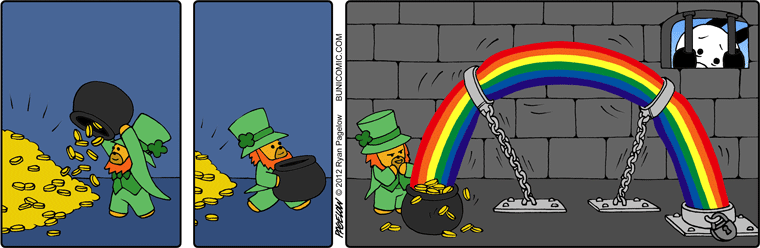
Tax the Leprechaun 1%.
- [SHOW]
Re: Our financial system is crumbling this week.
Posted: March 13 12, 10:04 am
by TimeForGuinness
longhornbaseball wrote:The job market for young people in America isn't exactly fun right now, but it could be a lot worse...
- [SHOW]
We really need the baby-boomers to die off...because they certainly aren't retiring due to healthcare costs.
Re: Our financial system is crumbling this week.
Posted: March 13 12, 5:39 pm
by AdmiralKird
TimeForGuinness wrote:longhornbaseball wrote:The job market for young people in America isn't exactly fun right now, but it could be a lot worse...
- [SHOW]
We really need the baby-boomers to die off...because they certainly aren't retiring due to healthcare costs.
Well they also lost out on about 4-5 years of retirement investment now that were just reaching pre-recession levels, so there's that lag as well. If the baby boomers had those years their retirement portfolios would be about 30-40% larger than their current values.
Re: Our financial system is crumbling this week.
Posted: March 13 12, 5:52 pm
by lukethedrifter
TimeForGuinness wrote:longhornbaseball wrote:The job market for young people in America isn't exactly fun right now, but it could be a lot worse...
- [SHOW]
We really need the baby-boomers to die off...because they certainly aren't retiring due to healthcare costs.
Feed em red meat
Re: Our financial system is crumbling this week.
Posted: March 13 12, 7:23 pm
by TheoSqua
longhornbaseball wrote:The job market for young people in America isn't exactly fun right now, but it could be a lot worse...
- [SHOW]
What the hell. I opened up that photo and thoughor acid or somethingt I took some LSD
Re: Our financial system is crumbling this week.
Posted: March 22 12, 2:14 pm
by longhornbaseball
Re: Our financial system is crumbling this week.
Posted: March 23 12, 4:01 pm
by G. Keenan
There is some serious food for thought in this
interview:
In a SPIEGEL interview, Czech economist Tomas Sedlacek discusses morality in the current crisis and why he believes an economic policy that only pursues growth will always lead to debt. Those who don't know how to handle it, he argues, end up in a medieval debtor's prison, as the Greeks are experiencing today.
Some highlights:
SPIEGEL: Does the human species define itself by its existential dissatisfaction?
Sedláček: The saturation point, like the end of history, is never achieved. Consumption works like a drug. Enough is always just beyond the horizon. The Marxist philosopher Slavoj Žižek put it this way: "Desire's raison d'être is not to realize its goal, to find full satisfaction, but to reproduce itself as desire."
SPIEGEL: Which is why life is ultimately a Sisyphean task?
Sedláček: The economics of equilibrium are doomed to failure. Eve's desire -- in economic terms, her demand -- will never subside. And Adams's offer to toil by the sweat of his brow will never be enough. In the film "Fight Club," based on the novel by Chuck Palahniuk, the protagonist Tyler Durden says to his nameless friend, who despises his profession in the auto industry: We work at jobs we hate so we can buy [expletive] we don't need. That is the expulsion from Paradise, transferred to the modern age.
Sedláček: We are clearly not communists by nature, but we are definitely communitarians. Only a truly egomaniacal person can live happily in a society in which he is the only rich one. Man has a need for fairness and, therefore, for a fair distribution of wealth.
SPIEGEL: So greed and empathy offset each other as balanced forces?
Sedláček: Yes. In his "Theory of Moral Sentiments," Adam Smith, the founder of modern economics, defines sympathy as the basis of morality and as the driving force of human activity. The suffering of one person also affects someone else.
SPIEGEL: But Smith is more famous for his most important work, "The Wealth of Nations," in which he questions the effects of human self-interest and the "invisible hand" of the market.
Sedláček: Self-interest guides human behavior, but Smith knew that man cannot be explained by the egoistical principal alone. He clearly distanced himself from his contemporary Bernard Mandeville and his theory that private vices generate public advantages, and that the general welfare stems from the self-interest of the individual. Contrary to his effective history, I believe that Smith's legacy consists in the incorporation of moral questions into economics -- in fact, that they are precisely what constitute its core. For modern economists, on the other hand, the question of good and evil is practically heretical.
Sedláček: The most positive, descriptive economic models have approached the question of how the market economy functions with complicated mathematical models for decades, but they are simply wrong or pointless at best. The real question should be: Is the economy working the way we want it to?
SPIEGEL: But it isn't up to economists to set ethical standards.
Sedláček: Yes, it is. Ethics forms the core of economics. It leads straight to the question of the good and right way of living, or Aristotle's concept of eudemonia. For him, maximizing benefit without maximizing good would have been pointless. A market economy without morality is a zombie system: The robots function perfectly, but in the end they leave behind a trail of devastation. We have to return to our origins and talk about the soul of the economy.